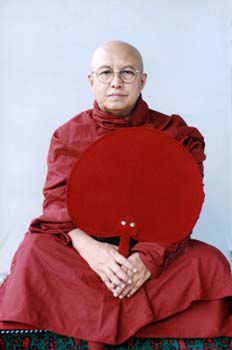
Welcome to the Chanmyay Satipatthana Vihara. The meaning of "Chanmyay" is peacefulness. "Satipatthana" means mindfulness constantly focused on the body, and mind. "Vihara" means (Buddhist) monastery.
Our Theravada Buddhist practice follows the Mahasi Tradition. In a small Village in Myanmar (formerly Burma), a temple had an unusually large drum. When the monks played the drum, the villagers came to the temple to hear the Buddha's Teachings. The temple was named after this large drum, Mahasi. The Abbot of this temple was Mahasi Sayadaw. Sayadaw is the Myanmar word for Teacher Monk. His teaching methods are taught and practiced today by meditators (yogis) in numerous countries, as well as our Association Members and the participants in our Meditation programs.
The main Center of our Teacher, the Chanmyay Meditation Center, is located in Yangon, the capital of Myanmar. The Venerable Chanmyay Sayadaw Ashin Janakabhivamsa, our Teacher, is the Abbot of this Center from which he is also named. The Venerable Chanmyay Sayadaw's meditation teacher was the Great Mahasi Sayadaw.
There are now approximately 6 centers in Myanmar. In response to requests by yogis, The Venerable Chanmyay Sayadaw has sent his disciples and experienced meditation teachers to other countries in order to spread Buddha’s teachings. There are centers in Thailand, Singapore, Indonesia, Malaysia, Canada, Newzealand, South Africa and the United States.
The Vihara (Residence) is located on a beautiful piece of property (6.5 acres) with many shady trees in a grassy meadow and has a peaceful and quiet atmosphere [525 N. Bruns Lane, Springfield, IL 62702] . Chanmyay Satipatthana Vihara is located in Springfield, the capital of Illinois, and is approximately 1½ hours by car from St. Louis, Missouri and 3½ hours by car from Chicago, Illinois.
During the visit of The Venerable Chanmyay Sayadaw in 2008, several devotees have pooled their resources and bought the adjacent property at 9 Harriet Lane which is located in front of the Vihara and donated it to The Venerable Chanmyay Sayadaw. Sayadaw named it as "Santa Vasa Vihara (Vihara meaning Abode)". Santa (in pali) means tranquil, peaceful, pure; Santa Vasa is translated as "a peaceful state".
We will be conducting retreats and special teachings as teachers become available to travel and stay at the Vihara. We are very grateful to have the opportunity to bring The Venerable Chanmyay Sayadaw to Springfield most of the years from Myanmar and to practice Vipassana meditation under his direction
All are welcome to join us and benefit from the practice. All that is required are good intentions, adequate motivation, observance of five or eight precepts, and a commitment to follow the instructions of the teacher. There is no requirement to be a Buddhist or to convert to Buddhism in order to participate and benefit from this mindfulness practice.
The teaching is free, however, Chanmyay Satipatthana Vihara is the nonprofit charitable organization and supported by the members and the meditators. Because of the generosity of Meditators and its Members the Chanmyay Vihara can offer the teachings free of charge. We appreciate the donation to cover the cost of utility and food when staying over night at Vihara.
Please contact us if you have any questions, wish to register for an activity. The Vihara can be reached at 217-726-9601. You can also send an email to SVA President, Padetha Tin at president@chanmyayusa.org or Secretary, Elizabeth Myint at secretary@chanmyayusa.org.
We are pleased to announce that the Most Venerable Chanmyay Sayadaw Ashin Janakabhivamsa is in Satipatthana Vihara, Springfield, Illinois from June 30th to July 28th 2015.
You are welcome to come and pay the respect to the Most Venerable Chanmyay Sayadaw at any time and anyone who wishes to go into meditation retreat here under close guidance of resident Sayadaws can do so at any time.
Enquiries can be made to the following committee members.
| |
Daw Dhammesi
Ph: 217-726-9601
Ph: 260-312-3022
E-mail: nanthwae@yahoo.com
|
|
| |
Dr. Elizabeth Myint
Ph: 217-220-1536
E-mail: emyint@att.net
|
|
| |
Daw Win Win Than
Ph: 440-334-8042
E-mail: lpwtin@sbcglobal.net
|
|
| |
Daw Yee Yee Thwin
Ph: 309-833-3908
Ph: 309-363-0942
E-mail: yythwin@hotmail.com
|
|
Chanmyay Sayadaw Ashin Janakabhivamsa is the Chief Abbot of all of the Chanmyay Yeiktha Meditation centers around the globe.
Ashin Janaka was born in Pyinma village, Taungdwingyi township, on Tuesday 24 July, 1928. His parents were U Phyu Min and Dhw Shwe Yee. At the age of 15 he was initiated at the Tawya Beikman Monastery as a Samanera (novice monk) under the tutelage of the Abbot, Ven. U Malvamsa receiving the name of Shin Janaka. He delighted in the study of Buddha-Dhamma devoting his whole time to studying the scriptures. After that, he continued his studies of English under Myaung-mya Sayadaw U Dhammananda of Pathein and returned to Mandalay Mahavisuddhayone University to fulfil his duties as a lecturer in Buddhist scriptures.
In 1954 he was invited by the state Buddha Sasana Organisation to perform Palivisodhaka (editorial duties. In 1957 the Ven. Sayadaw spent nearly six years at Mahavisuddharma Monastery, Colombo, Sri Lanka, where he continued his studies of English, Sanskrit, Hindi and Sinala language. While at Colombo he took the London G.C.E. (A level) examination and passed.
He returned to Burma in June 1963, and at the invitation of the state Buddha Sasana Organisation, he took up residence at Kaba-Aye where he edited the publications of Pali Texts.
In 1967 he performed the duties of Nayaka Sayadaw (Meditation Teacher) at Mahasi Sasana Yeiktha Meditation Centre under the instruction of the Most Venerable Mahasi Sayadaw and rendered assistance in the performance of Piriyatti (studies) and Patipatti (meditation practice) duties.
In the field of Patipatti the Ven. Ashin U Janaka performed the duties of Meditation teacher at Mahasi Sasana Yeiktha for five years and at Mandalay Yatanabon Sasana Yeiktha for about one and a half years.
In February 1979, the Venerable Sayadaw took up residence at Chanmyay Yeiktha Meditation Centre which was donated to him by a number of devotees, and spared no pain in performing the dual duties of Meditation Master in Patipatti as well as Pariyatti. He has been since then, known as the Chanmyay Sayadaw.
In 1979 - 1980 he accompanied the Most Venerable Mahasi Sayadaw's Dhamma Mission to Europe and the U.S.A. Between 1981 and 1985 he undertook Dhammaduta missions alone to twenty countries in Asia, Europe and the United States. From April 1979 to July 1995 the Venerable Sayadaw conducted several meditation retreats and delivered Dhamma Talks in twenty-five countries in Asia, Africa, Australia, Europe and the U.S.A.
In April 1995 some devotees in Hmawbi and Yangon donated the Sayadaw a ten-acre plot of land near Hmawbi to set up a meditation centre. The land is quiet and cool, with many big shady trees. On this land the Sayadaw's disciples have been constructing dormitories, meditation halls, meditation platforms, kitchens, dinning halls, etc.
In honour of Sayadaw's missionary work for the cause of the Buddhasasana, the Government of the Union of Myanmar conferred on him the titles of "Maha-Kammatthanacariya" (Great Meditation Master) in 1993 and "AggaMaha-Kammatthanacariya" (Great Noble Meditation Master) in 1995.
Chanmyay Yeiktha, Yangon, functions mainly as a meditation center but is also a monastery with resident monks (meditation teachers) and nuns. It is also for both local Myanmar meditators and foreign meditators.
Foreigners are well cared for and have their own living quarters and schedules. Single rooms are provided whenever possible. Men's and women's accommodations are separate, clean and simple, and complete with bed linen and mosquito nets. Additionally automatic washing machines are available.
Two healthy meals are served everyday, one at dawn, another before noon. Drinks such as orange juice are offered in the evening. Vegetarian food is available on request. In the dining hall, everyone eats slowly, quietly and mindfully. Clean, safe, hot and cold drinking water is supplied.
The electricity supply is 230V AC. The office has a telephone where international calls can be received or made and paid for. No reverse charge calls are available for either incoming or outgoing calls. There is a fax machine for emergency use only. Prepaid aerogrammes are not available so please bring your own writing paper and envelopes.
There is a medical clinic with doctors coming on a regular basis. "Western" and traditional medicines are available. Malaria is typically not found or reported in Yangon or central Myanmar. Please check with the WHO or the CDC for the latest updates on other areas. For immunizations please consult your doctor.
Yangon has a tropical climate which means it's mostly hot and humid. The rainy season is usually from about June to October. The cool dry season is form November to February and it can be quite pleasant and good for meditation. From March until June are the months which are mostly hot and dry.
Light, easily washable and quick drying clothes are useful. Loose fitting pants or the Myanmar longyi is practical and most yogis wear light, long sleeve cotton shirts.
Please write, phone, fax or e-mail details of your arrival and departure flights one week before arriving so you can be met on arrival and your departure scheduled. Transport is readily available. Mail can take up to ten days to reach us.
It is preferred that foreigners practice for at least one month. Please bring extra passport photos for the various forms. For less than four weeks, a tourist visa is adequate. However, for long periods, you must obtain a meditation visa before coming to Myanmar. This requires a sponsorship letter from our Teacher & Abbot, Chanmyay Sayadaw Ashin Janakabhivamsa.
For long term meditation, you are invited to ordain as a monk, novice or nun. It is an excellent opportunity and enhances your meditation experience in Myanmar, however it is not obligatory.
Lay meditators must observe the eight precepts. Talking is kept to an absolute minimum, as is reading and writing. We teach and practice insight (Vipassana) meditation according to the Satipatthana Sutta and the Mahasi tradition.
Meditators are expected to practice intensively, at least from 3:30 am to 9:30 pm everyday performing all activities slowly, to allow continuity of mindfulness and strong concentration.
Men and women have separate large meditation halls for sitting and walking meditation. These have a conducive atmosphere for meditation practice. There is a general daily timetable but the teacher gives specific meditation instructions to the meditators based on their individual experience and ability. Please follow the teacher's instructions, letting go of other practices.
Meditation instructions and interviews are given in English on alternate days. Sometimes an interpreter is used if an English speaking teacher is not available.